

Ever wonder why some Italian seafood tastes like it has a soul? It’s because the best dishes come with backstories more compelling than most Netflix documentaries.
Our executive chef’s journey started in Mediterranean fishing villages. It ended in Michelin-starred kitchens. Every menu choice is a piece of his story. It’s not just cooking; it’s turning coastal memories into food poetry.
Imagine Visconti directing a plate of branzino. Here, ingredients are characters in an Italian epic. Tradition meets modern techniques in every dish.
Why do the best seafood stories start with someone getting their hands dirty? We’re about to show you behind the scenes.
Top Signature Seafood Dishes
What makes our seafood dishes stand out? They’re like culinary poetry, leaving food critics speechless. They’re so good, they’re like opera performances.
Our fresh seafood pasta is a masterpiece. It’s not just pasta – it’s a work of art. Imagine your grandma’s pasta, but with a twist, thanks to Ferran Adrià and David Bowie.
Our squid ink tagliatelle with sea urchin butter is a hit. It turns adults into Instagram stars. The reason? It’s the perfect mix of pasta and seafood.
It’s like a dream come true for food lovers. The skill behind it is unmatched. It’s a true Italian comfort food experience.
| Signature Dish | Creative Twist | Texture Profile | Culinary Inspiration |
|---|---|---|---|
| Seafood Linguine | Deconstructed clam broth foam | Crisp-tender al dente | Roman tradition meets molecular gastronomy |
| Squid Ink Tagliatelle | Sea urchin butter emulsion | Silky with subtle resistance | Coastal Italian innovation |
| Scallop Cappelletti | Saffron-infused seafood reduction | Delicate pillowy texture | Northern Italian elegance |
| Lobster Tortellini | Citrus-butter air | Rich yet light mouthfeel | Mediterranean luxury reinterpreted |
This isn’t just dinner – it’s a show. Each dish is a story, where pasta and seafood are the stars. It’s like a performance that would make Shakespeare proud.
Plating & Presentation
If you think our plates are just for serving, you’re wrong. Italian seafood cuisine is about creating a feast for the eyes. Every dish is a story told through taste and sight.
Look at our crudo presentation. We arrange raw fish slices like a painter. Each piece is placed with care, each color chosen for its effect. Sea urchin’s orange against white porcelain is not random – it’s a message in food.
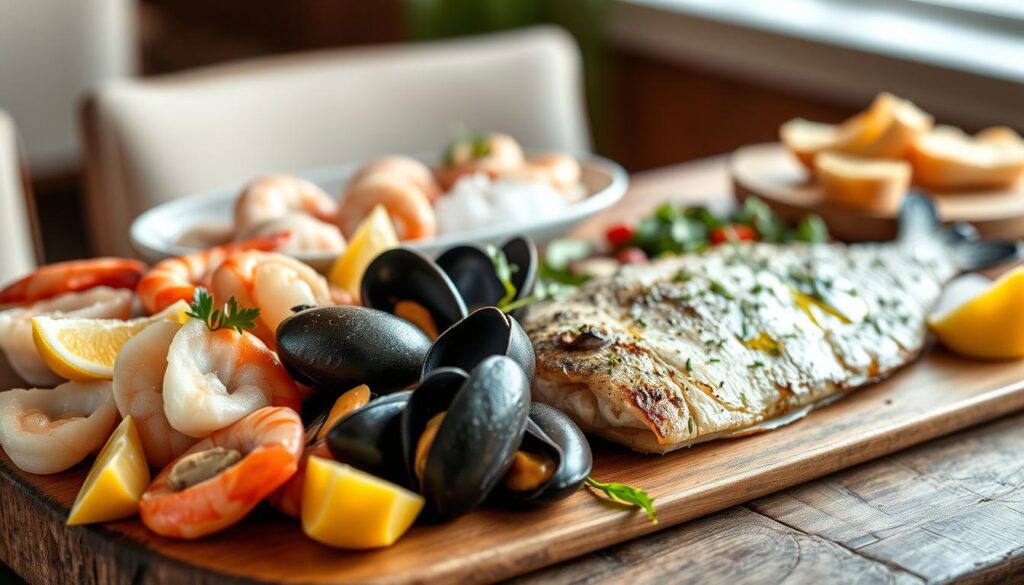
Top restaurants in Rome, like Aroma and Metamorfosi, use special ceramicware. The plate is as important as the food. Our bisque comes in bowls that look like art, blending food and container.
The empty space on our plates is not just space. It’s like a pause in music. It’s a sign of elegance, loved by both Japanese minimalists and Italian grandmothers.
We use three key plating techniques:
- Color contrast: Bright seafood against earthy ceramics
- Textural storytelling: Crunchy bits next to smooth sauces
- Architectural balance: Arrangements that look natural yet structured
The effect is striking. Red langoustines on dark slate are dramatic. Foam on grilled octopus hints at the sea. Each part tells a story before you eat it.
This isn’t just decoration. It’s like building a landscape with food. The plate is a stage, and the food, the performers. When done right, eating becomes a conversation and a cultural statement.
Ingredient Sources
Sourcing seafood is more than just managing supplies. It’s like a diplomatic effort that rivals the UN. Our ties with Italian fishermen are deep and personal, like a lifelong commitment. They’re always ready to help us get that perfect branzino, day or night.
Why do we go to such lengths? Because we believe in quality. Our fresh seafood pasta needs the best ingredients. We track every piece back to its exact spot in the Tyrrhenian Sea, with military precision.
The economic and ecological benefits are just as compelling. By supporting small-scale Mediterranean fisheries, we help people and protect the sea. It’s a win-win for everyone, blending business with a sense of responsibility.
It’s a delicate balance between the “fresh catch” dream and the reality of running a restaurant. We aim for the best of both worlds: freshness and sustainability. It takes skill and respect to make it happen.
Our branzino comes from the Tyrrhenian Sea, with all the details documented. We know who caught it, where, and when. It’s not just about quality; it’s about integrity.
Choosing sustainable seafood is the new luxury. It’s about enjoying your meal without harming the planet. We’ve learned from sustainable seafood recipes from Australia to keep our dishes authentic and eco-friendly.
The outcome? Our fresh seafood pasta is a treat for your taste buds and your conscience. You can enjoy the best of Mediterranean cuisine without feeling guilty. That’s true love.
Suggested Pairings
Choosing wine for seafood Italian dishes is like finding the perfect match. One wrong choice can ruin the dish. The right pairing is like a perfect date.

Why does Vermentino pair so well, while Chardonnay clashes? It’s because Vermentino’s acidity cuts through richness. It respects old traditions.
Italian whites are more than drinks. They’re a mix of intelligence and art. The MICHELIN guide shows how pairings can make dishes amazing.
Here’s what works (and what doesn’t) with our seafood Italian creations:
- Vermentino: Its mineral notes dance with grilled fish like perfect partners
- Pinot Grigio: Crisp enough to handle rich sauces without overpowering
- Unoaked Chardonnay: When you must go bold, choose wisely
Top restaurants show us that the best pairings are often unexpected. They’re like modern love stories.
Acidity is key against oily dishes. Minerality adds to the briny taste. Temperature is as important as the wine type.
Wine dinners teach us to let the wine and food have a conversation. The wine should enhance the dish’s story, not overpower it.
Great seafood Italian pairings feel like they were meant to be. They make sense in hindsight, like a perfect relationship.
Seasonal Variations
Ever wonder why your fresh seafood pasta tastes different in December than in July? It’s not just kitchen tricks. It’s a smart move to follow nature’s seasons. Our menu changes four times a year, making each dish unique.
It’s like eating with nature’s calendar, not just what’s on your phone. Summer dishes are like a Mediterranean beach – bright and fresh. Winter dishes are cozy, like an Italian fishing village in a storm.
Changing menus seasonally is a big challenge. It’s like running a theater where seafood is the star. We aim to keep dishes consistent while celebrating each season.
Spring fresh seafood pasta comes with tender peas and young fennel. Summer dishes have tomato sauces with basil and zucchini. Autumn brings mushrooms and squash. Winter is all about hearty broths and preserved lemon.
Why stick to seasonal variations? Serving autumn seafood in spring is like wearing Christmas sweaters in June. It shows a lack of respect for ingredients and their natural cycles.
The MICHELIN guide’s seasonal cuisine category is more than a trend. It shows that great cooking is about responding to its environment. Restaurants with seasonal menus get this. They know ingredients have seasons, and so should menus.
This approach makes farmers and foodies happy. It turns dining into a dialogue with nature’s rhythms.
Our winter fresh seafood pasta uses richer fish and deeper sauces. The herbs and presentation change too. But the dish’s essence stays true to us.
These seasonal variations are more than just menu changes. They show our dedication to noticing the world around us. In a world where everything is available all year, seasonal cooking is a form of resistance.
Gallery
In today’s world, food photos are more than just pictures. They prove our seafood Italian dishes look as good as they taste. Our gallery shows off the beauty of De Novo’s coastal Italian dining.
Our photos don’t follow the usual food pictures. They look like paintings that tell stories. The lighting makes our seafood glow naturally, not artificially.
Our style is inspired by fish art that celebrates the sea. Like these art pieces, our dishes are both beautiful and true to life.
Our gallery shows how important good photos are in the seafood Italian world. It’s where cooking meets photography, pleasing both chefs and photographers. These images don’t just show food; they share a coastal Italian way of life.