

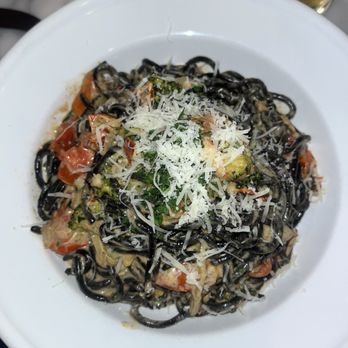
Some dishes announce themselves with volume. Others do it with composition. Black spaghetti with lobster bits, broccoli florets, tomatoes, sherry wine, and shallot cream belongs to the second group. On paper, it sounds almost too elaborate, like a chef daring the plate to hold together under the weight of its own ambition. But when a dish like this works, it does something far more interesting than impress. It creates balance out of ingredients that could easily pull in opposite directions.
That is what makes this style of pasta worth paying attention to in a town like Montclair, where diners tend to respond to food that feels both thoughtful and generous. Black spaghetti brings drama before the first bite even lands. Lobster adds sweetness and luxury, but in pieces rather than heavy-handed display. Broccoli florets introduce structure and slight bitterness. Tomatoes brighten the center of the dish. Then the sherry wine and shallot cream pull everything inward, rounding the sharper corners and giving the whole plate a finish that feels composed rather than crowded.
The result, at its best, is not a seafood pasta trying to overwhelm you. It is a restaurant dish built on contrast, and contrast is where serious cooking tends to reveal itself.
Why Black Spaghetti Changes the Mood of the Plate
There is a reason black spaghetti always feels a little more theatrical than other pasta shapes. Squid ink pasta does more than change the color. It changes expectation. The darker tone suggests depth before flavor has even had a chance to register. It tells the diner this is not going to be a soft, forgettable bowl of noodles dressed up with shellfish. It signals something brinier, moodier, and more self-aware.
That visual effect matters because pasta dishes often live or die by their first impression. A white cream sauce can look heavy. A tomato-forward seafood pasta can sometimes read as familiar to the point of predictability. Black spaghetti avoids both traps. It gives the plate elegance and a little tension, which is exactly what a dish built around lobster and sherry needs.
More importantly, squid ink pasta brings a subtle marine quality that helps the lobster feel integrated rather than merely added. That is the difference between garnish thinking and dish thinking. The lobster should not sit on top like an expensive afterthought. It should feel inevitable.
Lobster Works Better in Bits Than in Chunks
One of the smartest details in this dish is the use of lobster bits instead of oversized pieces. Restaurants too often confuse luxury with scale. Bigger is supposed to feel richer, more indulgent, more camera-ready. In reality, smaller pieces of lobster usually make for the better pasta.
Lobster bits distribute sweetness through the bowl. They allow each forkful to catch a little shellfish, a little sauce, and a little pasta without forcing the diner to navigate the plate in separate parts. That makes the dish feel designed rather than assembled. It also keeps the lobster from dominating a composition that depends on several quieter elements doing real work.
This kind of restraint is usually a good sign. It suggests a kitchen that understands the difference between featuring an ingredient and letting it take the dish hostage. Lobster should add dimension, not ego.
The Broccoli and Tomatoes Keep the Dish Honest
The easiest version of black spaghetti with lobster would lean entirely into decadence. Cream, shellfish, darkness, richness. That can sound appealing for about five minutes. Then the plate starts to flatten.
Broccoli florets and tomatoes are what keep this dish from collapsing into monotony. Broccoli contributes firmness and a welcome vegetal bitterness that cuts through the sweetness of lobster and the softness of cream. It gives the plate shape. Tomatoes do something different. They sharpen the flavor line and inject just enough acidity to keep the sauce from feeling sleepy.
Together, those two ingredients perform a kind of quiet correction. They remind the diner that richness is most satisfying when it is interrupted. A good pasta dish does not simply coat the palate. It moves across it.
There is also something distinctly restaurant-smart about pairing broccoli with lobster in a cream-based sauce. It is not the most obvious combination, which makes it more interesting. The broccoli prevents the lobster from becoming too precious. The lobster keeps the broccoli from feeling dutiful. Each ingredient lifts the other out of cliché.
Sherry Wine and Shallot Cream Give the Dish Its Intelligence
If black spaghetti provides mood and lobster provides allure, the sherry wine and shallot cream provide the dish’s intelligence. This is where the cooking either becomes memorable or settles for surface appeal.
Sherry has the kind of depth that flatters seafood without bludgeoning it. It brings nuttiness, acidity, and a slightly oxidative complexity that makes a cream sauce feel more adult. Shallots, meanwhile, offer a sweetness that is gentler and more refined than onion, especially when folded into cream. The combination is exactly the sort of detail that separates a polished pasta from a generic one.
Cream sauces need architecture. Without it, they turn into blankets. Sherry prevents that. It gives the sauce contour. The shallot builds aroma and softness underneath. Together, they create a base that supports the lobster and black spaghetti without muting either one.
For diners who love layered sauces, this is where the dish earns its place. The flavor should not read simply as creamy. It should read as creamy with lift, sweetness with edge, richness with tension.
A helpful reference point for understanding why sherry works so well in savory sauces is the broader role of fortified wines in cooking, which the team at MasterClass on cooking with wine explains particularly well. That kind of structure is what gives a dish like this depth instead of just weight.
Why This Dish Fits Montclair
Montclair has become the kind of town where diners expect more than comfort alone. They want dishes with a point of view. They want food that feels restaurant-specific, not interchangeable. Black spaghetti with lobster, broccoli florets, tomatoes, and sherry shallot cream fits that expectation because it lands somewhere between indulgence and composition.
It is not a minimalist plate, and it should not be. Part of its appeal is abundance. But the best version of it still feels disciplined. That balance is what makes it right for a dining scene shaped by both neighborhood loyalty and increasingly serious culinary ambition. A dish like this can feel lush without becoming gaudy, which is often where good restaurant cooking lives.
It also speaks to the kind of layered, slightly cosmopolitan food culture Montclair has grown into. Diners here are open to drama, but only when the technique backs it up. They respond to dishes that reward attention. In that sense, this pasta belongs in the same conversation as the kinds of composed plates that define a maturing local scene, much like we explored in our look at the Montclair restaurant town.
The Best Version of the Dish
The best version of this dish does not feel heavy, even though it is rich. The pasta should remain firm and glossy. The lobster should stay sweet and just-cooked. The broccoli should still have bite. The tomatoes should taste fresh enough to punctuate the cream rather than disappear into it. And the sauce should cling instead of pool.
Most of all, the plate should feel deliberate. Black spaghetti can sometimes encourage theatrics for their own sake. Lobster can tempt a kitchen into excess. Cream can hide a lack of precision. A well-executed version of this dish resists all three impulses. It uses elegance, sweetness, and richness as tools, not distractions.
When that happens, the pasta becomes more than a luxurious special. It becomes the kind of dish people remember in full sentences. Not just the lobster pasta. Not just the black spaghetti. The one with the broccoli, the tomatoes, the sherry, the shallot cream. The one where everything made sense together.
Why It Works
What makes black spaghetti with lobster bits, broccoli florets, tomatoes, sherry wine, and shallot cream compelling is not that it sounds expensive. It is that it sounds composed. Every ingredient has a reason to be there. Every element corrects or deepens another. That is how memorable dishes are built.
It is a plate that understands contrast without losing pleasure. Dark pasta against sweet shellfish. cream against acidity. vegetables against indulgence. It gives the diner drama, but it also gives them logic. And in a restaurant town, that tends to matter more than spectacle alone.