

solo dining trends are no longer a side note in restaurant culture. For Montclair readers who book a table between work, errands, a train ride, or a quiet evening out, the rise of the one-person reservation is worth taking seriously. The strongest recent data is national rather than Montclair-specific, so it should be read as a signal, not a local census. Still, it points to a practical shift: more guests are choosing restaurants without waiting for company, and operators are learning that a party of one deserves the same care as any larger table.
What Solo Dining Trends Mean Before Booking
The numbers explain why restaurants have reason to pay attention. OpenTable reservation data reported by Axios showed that from June 1, 2025, to June 30, 2026, U.S. reservations for one rose 23% year over year compared with June 2, 2024, to July 1, 2025. The same reporting said average spend per person for solo diners was $94, up 7% year over year, while the average per-person spend across all party sizes was about $60, according to Axios on OpenTable data.
Solo Dining Trends At The Host Stand
The clearest signal behind solo dining trends is not only that more people are booking alone. It is that many of them are comfortable doing it. A Toast survey published on September 18, 2025, based on 650 U.S. adults, found that 56% of respondents felt very comfortable dining alone; 36% said they dined solo weekly, and 6% said they did so daily, according to Toast solo dining insights. For a host, that changes the meaning of a one-top. It is not automatically a quick compromise seat, a waiting guest, or someone killing time. It may be the meal the diner wanted from the start.
Timing, Spend, And The One-Top
Toast’s survey also found that most solo dining happened at lunch, with 58% of solo meals taking place then, compared with 24% at breakfast and 18% at dinner. The time frame was compact, too: 65% of solo diners spent 20 to 40 minutes dining, and fewer than 5% stayed longer than an hour. That matters for Montclair-area restaurants because lunch and early evening service often depend on pacing. A diner alone may order with purpose, eat at a steady rhythm, and leave the table ready for the next guest without feeling rushed.
How Restaurants Are Adjusting Service
For restaurants, solo dining trends raise a service question rather than a novelty question. How should a dining room make a party of one feel expected? The answer starts with seating, because the first few minutes shape the meal. Toast’s survey found that about 56% of people preferred a small individual table when dining alone, while 18% preferred the bar, 9% preferred outdoor seating, and fewer than 3% preferred communal seating. That preference cuts against the old assumption that solo diners should automatically be steered to a bar stool.
Seats That Feel Purposeful
A good one-person table does not have to be large, but it should feel intentional. A small two-top near a window, a counter seat with enough elbow room, or a bar seat with space for a plate and a drink can all work. What feels less welcoming is a seat treated as leftover space. For diners, it is reasonable to ask for a small table rather than the bar if that is how they prefer to eat. For restaurants, it is smart to ask rather than assume. The data supports that choice: most solo diners in the Toast survey did not name the bar as their first preference.
Menus Built For One Appetite
The research notes that restaurants are adapting with options such as bar seating, individual tables, smaller portions, solo courses or tasting menus, outlets, and free WiFi. Those changes make sense only if they serve the experience rather than reduce it. A smaller portion should still feel complete. A solo course should not read like a stripped-down version of the menu. Outlets and WiFi may help at lunch, especially for guests working while eating, but hospitality still depends on timing, warmth, and clear ordering guidance. A server who explains which dishes work well as a solo meal can make the difference between a functional stop and a satisfying restaurant visit.
What Montclair Diners Can Ask For
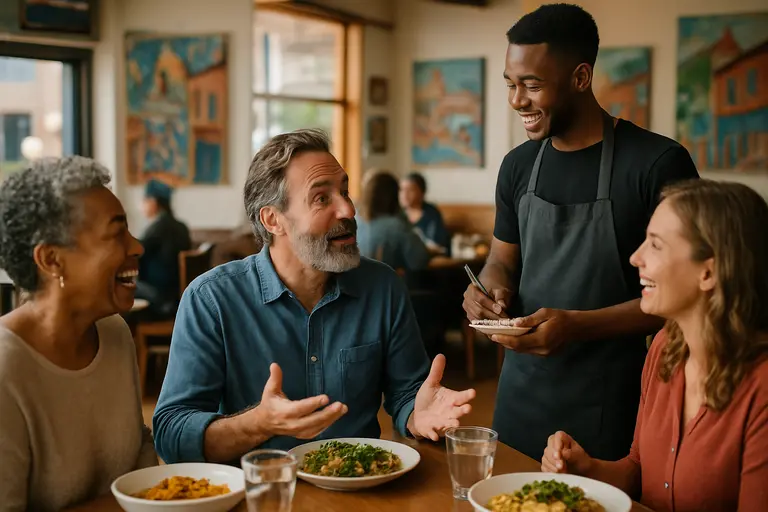
Because the available data is national, no one should claim that every Montclair dining room is seeing the same increase at the same rate. The practical lesson is still useful. If more diners are comfortable eating alone, guests should feel free to book clearly, arrive confidently, and state what kind of seat they prefer. For restaurants, the guest count should not lower the level of care. One diner can be a regular, a generous spender, a careful observer, and a future advocate for the dining room.
Choosing A Seat Without Apology
A solo reservation works best when expectations are clear. If you prefer a table, write that in the reservation notes when the platform allows it. If you are happy at the bar, say so. If you need to be out in 40 minutes, share that early. None of those requests are excessive; they help the restaurant pace the meal. Readers who want more practical advice on confidence, ordering, and seating can use this related piece on solo dining tips as a companion before booking.
Reading The Room Before Ordering
Solo diners often notice service details that larger parties miss. They see whether staff check in too often, not enough, or at the right moment. They notice whether a restaurant gives them time with the menu or tries to move them too quickly. A useful approach is to order in a way that fits the room. At lunch, a main dish and a drink may be enough. At dinner, one appetizer and one entree may feel more relaxed. If a restaurant offers smaller servings or a tasting option for one, ask how the pacing works before ordering.
Not every meal for one has to happen in a restaurant. Some diners may want the same sense of care at home, especially for small gatherings, work dinners, or quiet celebrations. For readers exploring alternatives to dining out, Personal Chef Mall is a related site in the same network that complements the broader dining discussion.
Solo Dining Trends In Restaurant Culture
Solo Dining Trends In Restaurant Culture is really a story about permission. The guest no longer needs to explain why no one else is coming. The restaurant no longer needs to treat the table as less valuable because it has one setting. The data shows comfort, frequency, and spending strength, but the cultural meaning is quieter: dining alone can be ordinary, pleasant, and socially accepted.
For Montclair diners, the best response is simple. Book the meal you want, ask for the seat that suits you, and order at the pace that fits the day. For restaurants, the opportunity is just as clear. A thoughtful one-top can build loyalty without dramatic changes to the dining room. Treating solo dining trends as a normal part of service, rather than a special case, makes the meal better for the guest and more predictable for the house.