

When a legacy restaurant closes, it leaves a distinct void in the local culinary ecosystem. For decades, Daikichi was the undisputed fortress of traditional sushi in Montclair. Its eventual closure was mourned by a dining public that had grown accustomed to its uncompromising standards. However, culinary talent of that caliber rarely stays dormant for long.
The arrival of Chef Kenny Mar at De Novo European Pub on Bellevue Avenue represents more than just a change of address for a beloved local chef. It is a bold structural shift in how Upper Montclair approaches dining. By installing a high-end sushi bar inside a space celebrated for house-made pastas and braised meats, owner Demetri Malki has engineered what we are calling a “Pub-Plex”—a dual-identity restaurant that refuses to compromise on either front.
Integrating raw fish into a European pub environment is a massive operational risk. If executed poorly, it reads as a disjointed gimmick designed to capture a broader market share. But under Chef Mar’s direction, the sushi counter operates as a standalone masterclass that simply happens to share a roof with exceptional Italian fare.
The Architecture of the Pub-Plex Fusion
The term “fusion” has been heavily diluted over the last two decades, often used to excuse chaotic menus that lack a core identity. De Novo succeeds specifically because it avoids traditional fusion. Chef Mar is not attempting to fold sushi ingredients into pasta dishes. Instead, he maintains a strict operational boundary between the two culinary disciplines.
The sushi bar commands its own physical and psychological space within the historic train station setting. Sitting at the sleek wood counter shifts the diner’s perspective entirely. The rustic, industrial charm of the pub fades into the background, replaced by the rhythmic, exacting knife work required to break down premium seafood. This division of labor allows the restaurant to offer remarkable range without diluting the authenticity of either menu.
Precision and Sourcing at the Counter
Sushi is an exercise in vulnerability. Unlike braises or complex pan sauces, there is no culinary sleight of hand to mask inferior ingredients. The success of the dish relies entirely on sourcing and knife technique. Chef Mar’s tenure at Daikichi instilled a profound respect for ingredient integrity, a philosophy he has successfully transplanted to Bellevue Avenue.
The Bluefin Tuna and Yellowtail Belly are sourced with an uncompromising eye for freshness and fat content. The buttery texture of these cuts requires minimal intervention—perhaps a light brush of nikiri soy or a microscopic dab of fresh wasabi. For diners observing from the counter, watching the preparation is akin to watching a master cellist. There is a deliberate cadence to the slicing that translates directly to the palate. For an excellent breakdown of the rigorous standards behind this style of chef-driven dining, the Michelin Guide’s exploration of the omakase tradition offers valuable context on the trust required between chef and diner.
| The Sushi Menu | The Culinary Identity |
| The Daikichi Legacy Rolls | Precision-driven classics that prioritize pristine fish sourcing and exact rice temperature. |
| Bluefin Tuna Nigiri | A masterclass in minimalism, allowing the buttery fat content of the fish to carry the palate. |
| The De Novo Signature Roll | A brilliant, measured crossover utilizing spicy crunchy tuna, avocado, and balsamic reduction. |
| Omakase at the Counter | A highly curated, chef-directed tasting experience that commands the room. |
Bridging the Culinary Divide
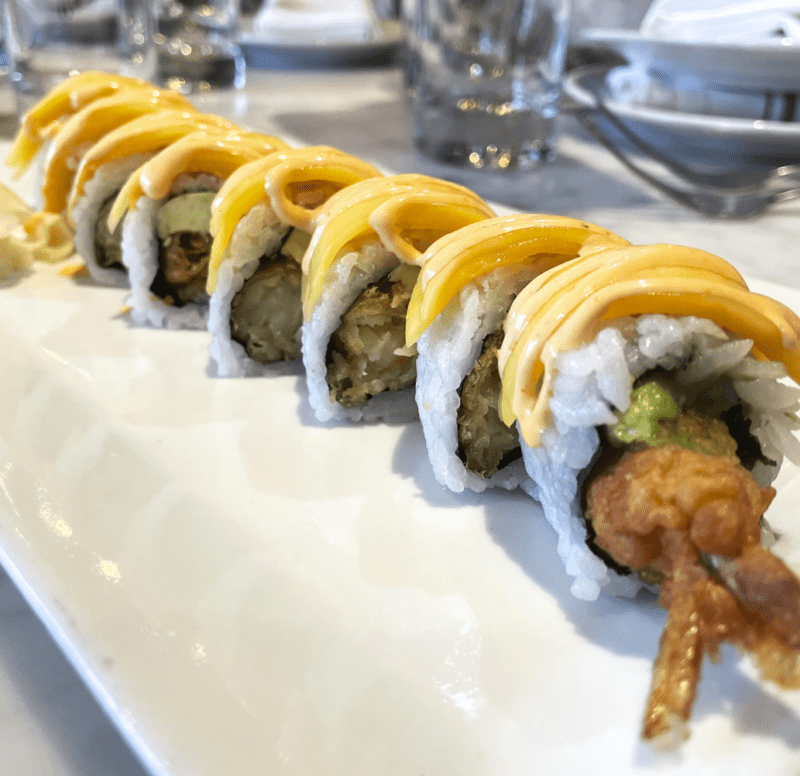
While Chef Mar largely keeps his traditional Japanese techniques insulated from the European menu, there is one deliberate point of intersection: The De Novo Signature Roll. It is the single dish that attempts to bridge the gap between the two kitchens, and it does so with surprising elegance.
Featuring spicy crunchy tuna topped with avocado, the roll is finished with a hint of balsamic reduction. On paper, introducing an Italian vinegar to delicate raw fish sounds heavy-handed. In practice, the balsamic acts much like a traditional eel sauce—providing a sweet, acidic viscosity that cuts through the rich fat of the tuna and avocado. It is a clever, restrained nod to the house style that proves the two kitchens can occasionally collaborate without losing their respective dignities.
Why Bellevue Avenue Needs This Evolution
Upper Montclair is a demanding market. Diners here expect neighborhood accessibility paired with serious culinary ambition. The resurrection of Chef Mar’s talents within the walls of De Novo answers this demand perfectly. It allows a table of four to seamlessly navigate between a craving for pristine sashimi and a desire for short rib agnolotti, without ever feeling like they are eating in a food court.
This level of architectural menu design is precisely what keeps a restaurant relevant. It respects the history of the town while aggressively pushing its dining culture forward. As we continue to document the evolution of the local scene in our Montclair restaurant reviews, the De Novo sushi counter stands out as a triumph of execution. The Daikichi legacy is not just surviving on Bellevue Avenue; it is actively setting a new standard for what a modern, multi-faceted restaurant can achieve.